The Feast Day of St. Mungo
The Feast Day of St Mungo or St. Kentingern, as he is also known, falls on the 13th January. This is the day when he took his last breath in the year 613 A.D.When he died, he was around 95 years of age. and loved & worshiped by many. Not much is known about his life and scholars have cross referenced many historic documents and pieced together St. Kentigern’s life story who has become known as one of the heroes of the age of the saints in early medieval Britain.
Historians over the centuries always have faced one crucial problem – whenever there is a gap in the knowledge or the recording of a life story, there always is the temptation to fill it in. The main source of St. Kentigern’s life story is the 12th century legendary biography requested at the time by Herbert, bishop of Glasgow between 1147 and 1164. During that time window, David I and later Malcolm IV were kings of the Scots.

The author of that first biography remains anonymous. He gives an account of his early life, which began under tragical circumstances in the county of Fife.
His mother was the Brittonic princess Teneu of the ancient kingdom of Gododdin (today known as Lothian).
She is also known as St. Enoch and often regarded as secondary patron saint of the City of Glasgow. The story of Princess Teneu is a tragic one. When her father, King Lleuddun (Lot) learned that she was with child after having been raped by the Welsh Prince Owain mab Urien, King Lot sentenced her to death.
She was thrown down Traprain Law, a hill east of Haddington in East Lothian. Miraculously, she survived the fall and was consequently set adrift in a small river boat without ores on the Firth of Forth. Condemned to certain death once the boat would reach the open North Sea. As it was, the little coracle was caught by a current that pushed her across the River Forth and on to the shores to the village of Culross. (Picture shows Culross village)
Teneu was found and rescued by the Christian community of St. Serf. It is here where Teneu gave birth to her son Kentingern (chief prince). The child was raised by St. Serf in the Christian faith and St. Serf is said to have given him the nickname Mungo, which means “dear one”.
While St. Mungo was growing up, he would have been taught the daily practises of Christianity. He was most certainly educated and trained to become a priest, possibly by St Serf himself. This special attention would have been the cause for dislike and jealousy by his fellow students.
Preserving the life story for generations to come
The best known record to reflect the life of St. Kentigern and which is regarded as a complete and full length work, is the one by a monastic writer of a Cistercian order, called Jocelyn of Furness.
He was a well known author of saints lives in his time. Jocelyn of Furness penned down the life of St Kentigern on the request of his namesake Jocelyn, Bishop of Glasgow (between 1175 – 1199). This Jocelyn became bishop in Glasgow after serving as Abbot of Melrose Abbey.
A copy of the book can be found at Glasgow City Archives, the original is in the Marsh Library in Dublin.

All the stories that we know today about St. Mungo and all the related lives and liturgical texts. were taken forward from these two early manuscripts, written nearly 600 years after the death of the saint.
Although it is impossible to say if all of it is accurate, what these these two works of historic biography show us today that St. Mungo played an important role in the life of the people during the time when they were written.
St. Mungo/St. Kentigern certainly lived. This is evident in a source reference that dates earlier than the 12th century and records the time of his death. This reference is the “Annales Cambriae”, which was compiled nearly 200 years after his death. Again, another vital clue that proves the importance of St. Kentigern at the time in church history.
Let’s find out, how his story continues and how he eventually arrived in Glasgow:
When he became of age, he left the community in Fife and began his own vocation of Christian ministry. He traveled to Kernach near Stirling to visit a friend called Fergus. When he reached the home of Fergus, he found him on his death bed.
Fergus requested that Kentingern would take his body on a cart drawn by two bulls. Kentingern was to accompany the cart and bury Fergus’ body wherever the bulls would stop.
Kentingern honoured the last wish of his dear friend and began the solemn journey in westerly direction. After about 30 miles, he had reached a beautiful green and lush glen, with a great rocky formation on one side and a small burn running at its foot. The bulls stopped to rest and drink water from the burn and it is here where Kentingern buried Fergus. He named the place “Glasgu” which translates into “dear green place”.
According to the works of Jocelyn of Furness, St. Kentigern had several roles to play upon his arrival at Glasgu. Among them, he is named as the founder of the church of Glasgow and rescuer of the Christian faith in the Kingdom of Strathclyde.
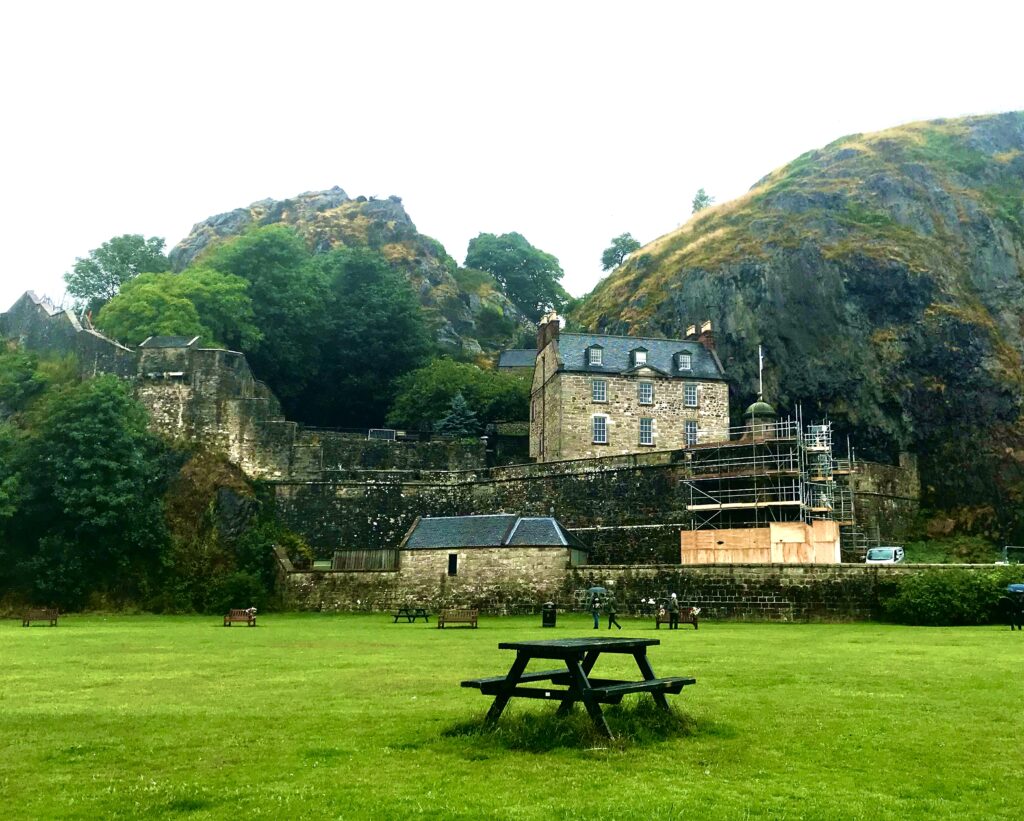
Above: Dumbarton Rock with Dumbarton Castle (own source picture), once seat of the ancient Kingdom of Alt Clut and Strathclyde
The Kingdom of Strathclyde
The Kingdom of Strathclyde as described by Jocelyn, was not quite the same as the one in place when Kentigern was alive around mid 6th century to the beginning of the 7th century. During this time, the Kingdom of Strathclyde was ruled from a fortress high on top of Dumbarton Rock on the banks of the Firth of Clyde.
It reached all the way down the Clyde Valley and Ayrshire, most likely incorporating the areas of Southern Argyle in the west.
It certainly had a turbulent history with Viking raids, which brought upon a drastic political change. The Britonic Kingdom with its distinct dialect of the region (cumbric), closely related to Welsh moved its royal Capital in the 9th century from Dumbarton Rock further inland next to Govan, where a royal church was established. It was then that the Kingdom of Strathclyde became known as the Cumbria. It had a much bigger reach down south beyond Carlisle and close to Penrith. Through this and its recognition by British Kings, the Kingdom of Strathclyde managed to survive into the 11th century. Preserving its Brittonic dialect of the region, along with its accompanying culture.
Walking the pilgrims way
At around the same time, Kentingern also founded the bishopric of Llanwelwy in the north of Wales, as well as in other areas throughout the country. This explains the various dedication sites to Saint Kentingern south of the River Clyde. Areas such as Cumberland, Dumfriesshire, Roxburghshire, Lanarkshire and Lothian are featured on various parts of the Saint Kentingern Pilgrimage route.
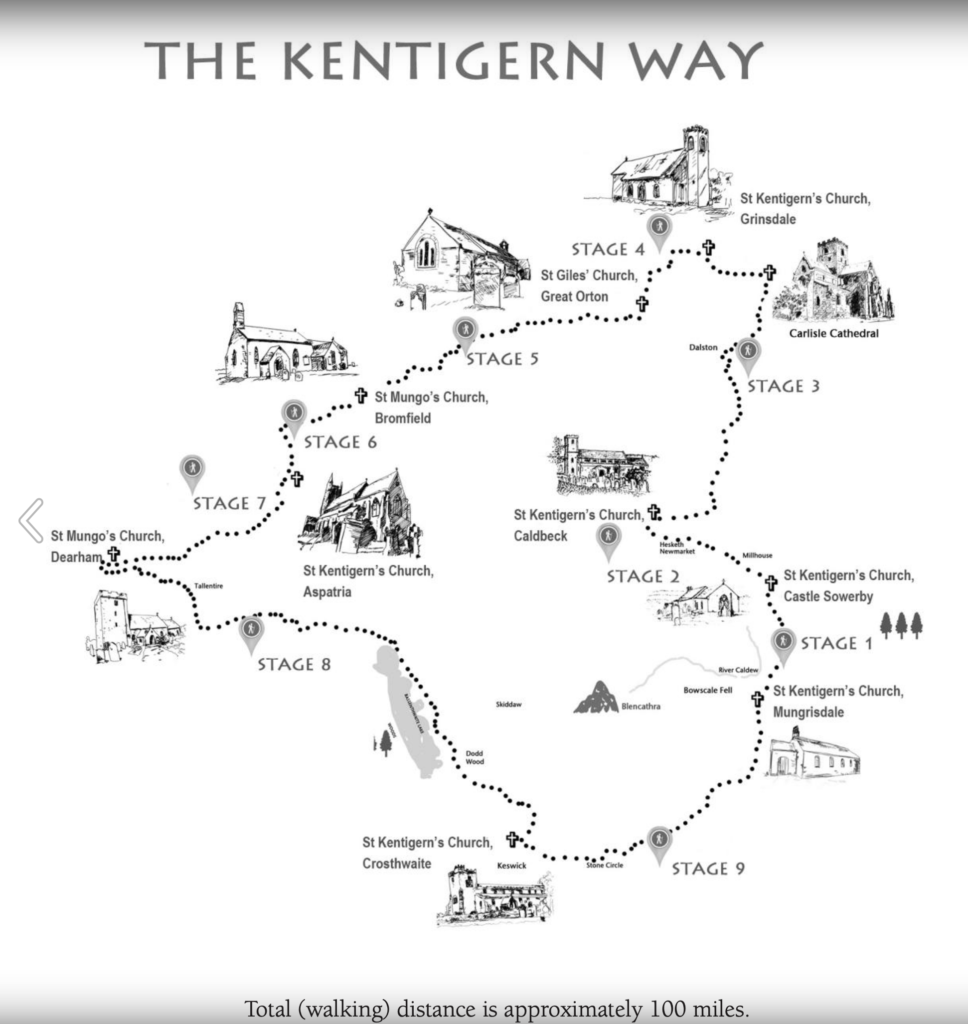
There is a route that takes in the stages of his conception, birth and death from Traprain Law to Aberlady and then on to Culross and Glasgow. Another really good pilgrimage route takes you around the Northern Fells of Cumbria and has been
compiled in a book by Stephen G Wright, published in 2019 by Wild Goose Publication. Below is an image of the route map from his book.
His presence is filled throughout the city
Today, St. Kentingern is the patron saint of Glasgow and his crest is seen all over the City. His crypt, which is said to may be empty, can be visited at Glasgow Cathedral. Little is known about the early buildings that stood here. St. Kentingern may have started out with only a modest wooden church, serving a small rural population in the beginning. However, the present building was started in 1136 and consecrated in 1197.
His remains were interred in a specially-constructed tomb in the new crypt (located behind the present high altar and directly above the current tomb in the lower church) in the mid-13th century. This quickly became a place of pilgrimage and provided a steady revenue stream for the Cathedral.
During the reformation in the mid-16th century, Cardinal Beaton is said to have removed many of the Cathedral’s possessions and relics and fled to France with them for protection. Whatever he took is lost forever. No-one knows where those items ended up.
It also remains a mystery, whether or not St. Kentingern’s relics are amongst those items lost or if they have been moved to a secret location within the cathedral itself.

Throughout the City of Glasgow it is possible to spot the miracle symbols by which St Mungo/St Kentingern is known for.
Here is the bird that never flew.
Here is the tree that never grew.
Here is the bell that never rang.
Here is the fish that never swam.
The City’s Motto was registered at the Lyon Court in 1866:
LET GLASGOW FLOURISH
A curtailment of the text inscribed on the bell of the Tron Church cast in 1631 –
“Lord let Glasgow flourish through the preaching of thy word and praising thy name.”
Whenever you visit Scotland’s largest city next, make sure to set aside some time to visit those places nearby relating to St Mungo/St. Kentingern.
Take a guided walk through the streets of Glasgow and listen to the amazing stories your guide can entertain you with and allow Glasgow’s history come to life.