James Watt - a mathematical instrument maker and inventor

James Watt was born in Greenock, some 27 miles west of Glasgow City Centre, on 19th January 1736.
He was the oldest of five children. His father, James Watt snr., was a ship owner, shipbuilder and contractor and his mother, Agnes Muirhead, came from a prominent old Scottish family, who according to her husband was “a woman with pleasing, graceful manners, a cultivated mind, excellent understanding and cheerful temper”.
She took up the early education of her then eldest son, before he later attended Greenock Grammar School.
It became very quickly evident, that he was really good at mathematics. A skill, that he most likely inherited from his grandfather Thomas Watt, who was a teacher of mathematics, surveying and navigation.
Upon leaving school, James W. helped out in his father’s businesses and again demonstrated the skill of creating great engineering models. He loved to repair nautical instruments and his father even made him his own set of tools in recognition of his talent.
“An explorer of many things, and a great man.”
Andrew Carnegie

This is a surveyors compass, which was produced around 1760 by John Morgan.
Picture source: National Museum Scotland. Licensor www.scran.ac.uk
On the road to engineering greatness

Picture Source: By Roger Griffith – James Howie. The Scots Worthies. Blackie & Son, Public Domain, https://commons.wikimedia.org/w/index.php?curid=5969446
When James W. was around 18 years of age, he left Greenock and moved to Glasgow and later to London, where he trained to become a mathematical instrument maker.
Once he completed his apprenticeship, he came back to Glasgow and the University employed him in 1756 as an instrument maker. Lodgings and a fully equipped workshop came with the job.
At the time, the university building was still located at it’s original location on the High Street. It remained there until 1870, when it was relocated to its present location on Gilmorehill.
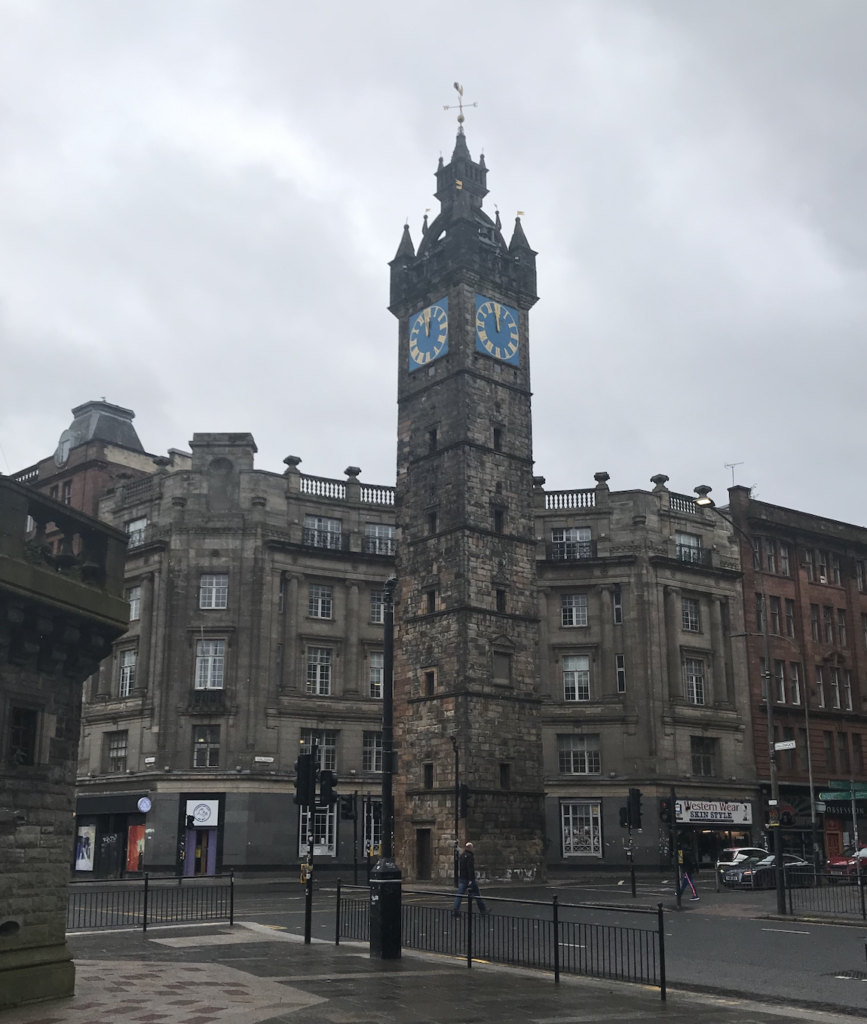
Watt’s work shop is said to have been in the building of the Tollbooth. Today, only its lonely steeple is left at Glasgow Cross, as can be seen here in this picture. (Picture source: © K. Devine)
This building was not far from the original location of Glasgow University, nor was it far away from the River Clyde.
Whilst repairing and attending to scientific instruments used in the university and attending to his business manufacturing microscopes and other optical instruments that he ran in partnership with John Craig, he was eventually asked by Professor John Anderson to have a look at one of the university’s Newcomen steam engines. It wasn’t functioning properly anymore and in great need of repair.
Watt had always been intrigued by the properties of steam. Ever since, aged 15, he was sitting with his aunt Mrs Muirhead at the tea-table in Greenock, carefully watching the lid of the kettle being lifted by the steam of the boiling water.
Immediately his mind was occupied studying the steam engine model from Thomas Newcomen in great detail. And he was determined to finding ways of improving the engine rather than simply repairing it.
A couple of years later, while still mauling over the subject of improving the engine, he was on one of his regular walks along the river banks of the Clyde on Glasgow Green.
It is there that he realised that having a separate chamber for steam to condense, it would allow for the engine to run much faster on less fuel. Once the idea had seeded in his head, he need to find ways to make it happen.
At the time however, James did not have the required financial safety net he required to embark on such a great invention. Fortunate for him, another University professor called Jospeh Black (later known as the chemist of the enlightenment) had connection to the industrialist Dr. John Roebuck. Black spoke highly of James and recommended him to Roebuck “to invest in Watt”.
Dr. Roebuck was the founder of the Carron Iron Works and based at Kinneil House, near Bo’ness.
He paid off Watt’s debts and requested 2/3 share of the patent for Watt’s invention. James Watt agreed and set up a workshop beside Kinneil House to begin with his work.
In 1769 Watt patented his steam engine design.

Picture Source: www.ourstoriesfalkirk.com
Several years later, Dr Roebuck encountered financial difficulties and had to give his 2/3 share of the Watt patent to one of his associates, Matthew Boulton, as he owed him money.
This prompted James Watt to pack up his workshop and partner up with Boulton at his factory in Birmingham.
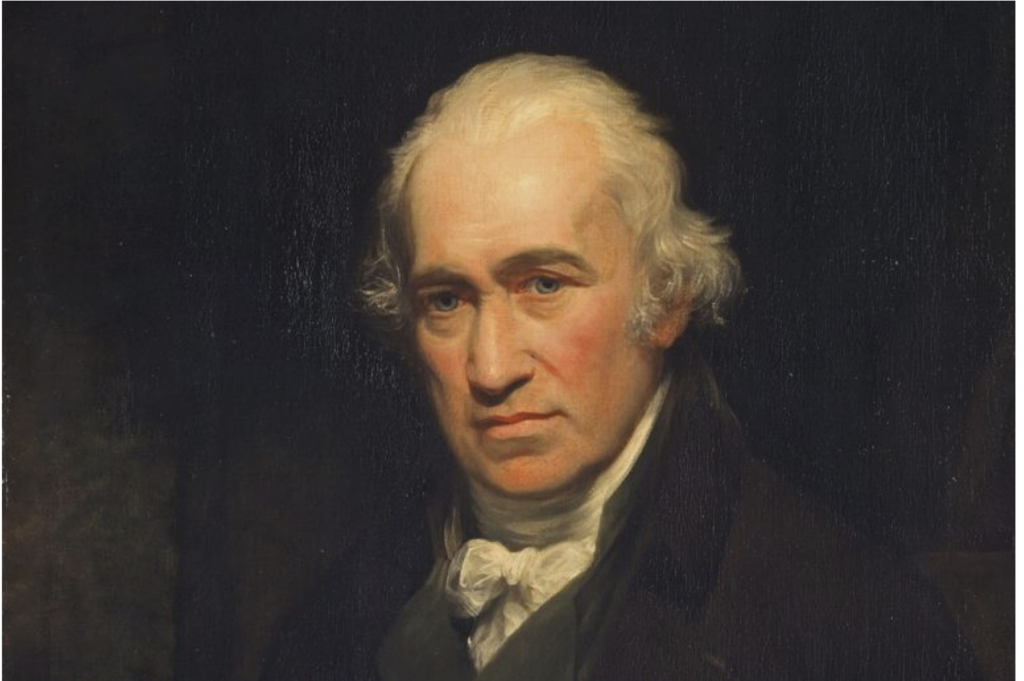
Picture Source: James Watt, 1736 – 1819. Engineer, inventor of the steam engine, by John Partridge; after Sir William Beechey, 1806. Oil on canvas.
National Galleries Of Scotland / Getty Images
Watt also had to overcome the loss of his first wife Margaret, who died in childbirth. It is very likely that this tragic loss, aided his decision to move to Birmingham in 1774. He would later only come back to Scotland when he visited his family.
In 1776 he found love and happiness again and married Ann MacGregor.
His business partner proved to be very useful. Not only did he have great engineering works, but he was also able to drill a perfect circle, by joining forces with John Wilkinson.
Aside: The Encyclopædia Britannica has produced an excellent little video, which you can watch here: https://www.britannica.com/biography/James-Watt/images-videos#/media/1/637673/194033
Together, the Boulton & Watt company embarked to new heights. They continued to improve the patent and apply it for different industry sectors. Both, Boulton snr. and Watt snr. involved their sons into the business, which took up new directions.
The improved steam engine was applied in flour, cotton and iron mills, as well as steam locomotives.
Boulton and Watt had “made it”. Watt continued to engage his inventive mind even after he took his well earned retirement. He would invent machines to copy medallions, a sculpturing machine that could reproduce original busts and figures etc.
In 1800, his patent for the steam engine ran out and so did his partnership with Boulton. He decided not to renew his patent, which opened the way for other brilliant engineers to come up with their own designs and inventions. For example: Henry Bell, who modified Watt’s design and created a smaller steam engine that could power the first steam ship THE COMET.

Leaving his legacy behind
On 19th August 1819, James Watt died aged 83. He lies buried alongside his business partner, Matthew Boulton at St Mary’s Church in Handsworth.
He left his legacy to the world and has been credited to be a driving force behind the Industrial Revolution.
In 1882 he was honoured by naming a unit of measuring electrical and mechanical power after him. We use it every day.The unit of WATT.
Statues are erected of him throughout the country. His statue located at St. Paul’s Cathedral, you can read the words: