Scotland's ancient Capital unveiled
Dunfermline, situated in Fife, Scotland, boasts a rich tapestry of history dating back to ancient times. Its origins are intertwined with the rise of Celtic settlements, evidenced by archaeological findings dating as far back as the Bronze Age. However, it was during the early medieval period that Dunfermline began to truly flourish.
In the 11th century, King Malcolm III of Scotland chose Dunfermline as the site for a royal residence after he married his Queen Margaret (a Hungarian/English princess) in 1070. To mark the occasion, Margaret founded a bigger church in Dunfermline and established a ferry service for pilgrims to travel across the Firth of Forth. This is how the towns South and North Queensferry came to be. The abbey attracted pilgrims from far and wide, thus contributing to Dunfermline’s prosperity and cultural significance. As the abbey grew in stature, so too did the town around it, evolving into a bustling center of trade and industry.
With its strategic location and royal connections, Dunfermline played a pivotal role in shaping Scotland’s early history, leaving an indelible mark on the nation’s narrative. Over the centuries, Dunfermline continued to thrive, witnessing periods of both prosperity and adversity. Its status as a royal burgh granted it certain privileges, fostering economic growth and cultural exchange. Despite facing challenges such as wars and political upheavals, Dunfermline persevered, retaining its significance as a beacon of Scottish identity and heritage. Today, Dunfermline stands as a testament to its storied past, with its historic landmarks and vibrant community preserving its legacy for future generations to cherish.
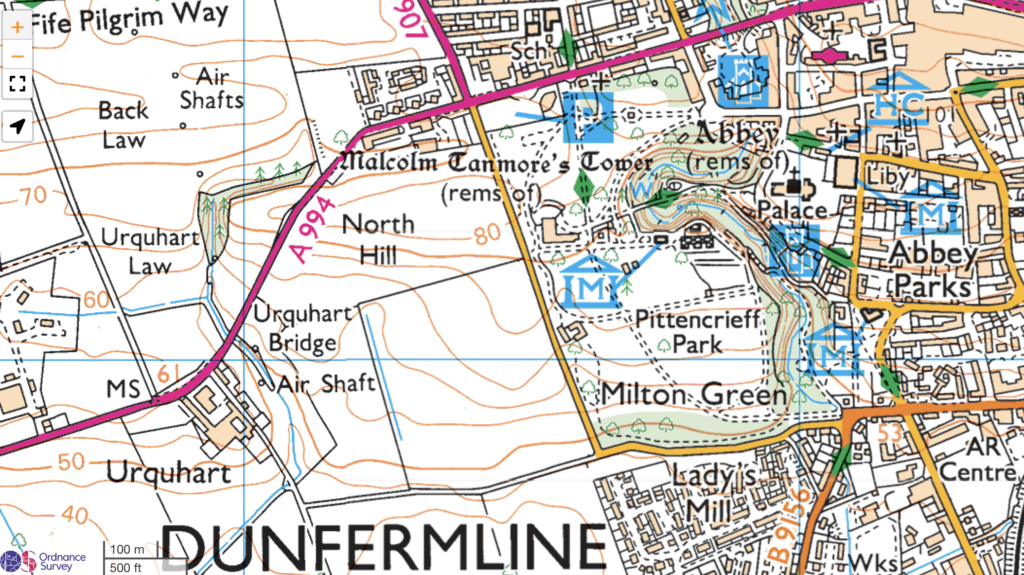
Ruins of Malcolm Canmore's Tower
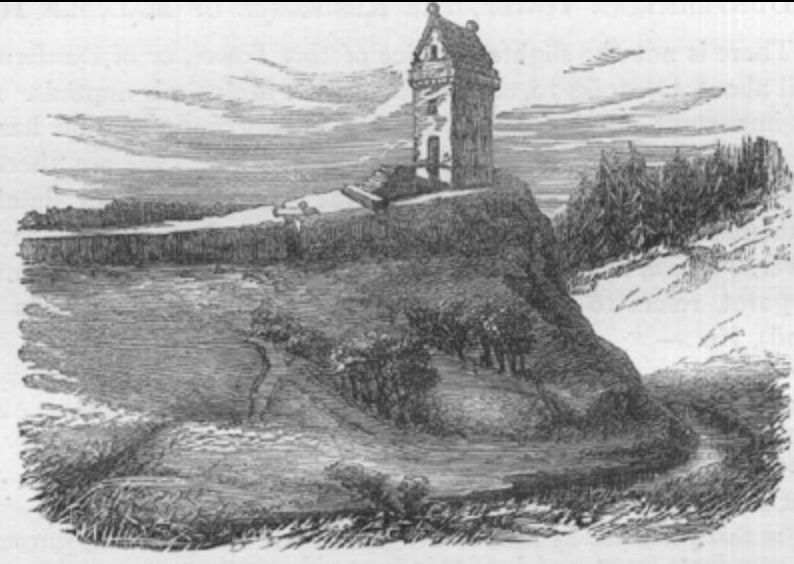
Unfortunately, not much is left from the ancient tower house that once stood just a short walk away from the Abbey on top of a gorge overlooking the a burn below.
The information plaque nearby read as follows: “There is no historical mention of the tower of Dunfermline until about AD1070, when Malcolm Canmore and his Queen-Princess Margaret- celebrated their wedding.
Dunfermline takes its name from three Celtic words – DUN (a hill or fort), FEARAM (bent or crooked) LIN, LYNE or LINE (a pool of running water). The tower was adopted at an early date for the Burgh arms of Dunfermline and old wax seals show it to have been a building of two storeys with attic, about 52 feet from East to West, and 48 feet from North to South. It contained about twenty small apartments. Before the roadway to the South , which was the western access to the town, was formed, the tower perched on its peninsular rock, was an almost impregnable fortress. This fact no doubt let to Dunfermline’s Motto: ESTO RUPES INACCESSA. Historians are of the opinion that the tower was where: “The King sits in Dumferling toon, drinking the blood-red wine…” – opening lines from a traditional ballad by Sir Patrick Spense.
The Royal Palace
Let’s look at the illustrious Royal Palace of Dunfermline, a majestic edifice steeped in centuries of history and regal splendour. It was constructed in the 12th century by King David I of Scotland and served as a cherished residence for Scottish royalty for centuries to come. Within its walls, monarchs held court, alliances were forged, and pivotal decisions that shaped the course of Scottish history were made. One of the most significant events to transpire within the palace’s hallowed halls was the birth of Charles I in 1600, marking a poignant moment in both royal and Scottish history. Over the centuries, Dunfermline Palace witnessed the comings and goings of monarchs, from the illustrious reign of Robert the Bruce to the tumultuous times of the Stuart monarchs.
From its inception, Dunfermline Palace stood as a symbol of power and prestige, reflecting the grandeur of Scotland’s royal heritage. As a favored residence of medieval monarchs, it played host to lavish banquets, diplomatic gatherings, and royal ceremonies, further cementing its status as a cornerstone of Scottish monarchy. Despite enduring periods of conflict and upheaval, the palace remained a steadfast bastion of regal authority, leaving an indelible mark on the landscape of Scottish history. Join us as we journey through the corridors of time, unraveling the captivating story of Dunfermline Palace and the pivotal role it played in shaping the destiny of a nation.
Dunfermline Abbey
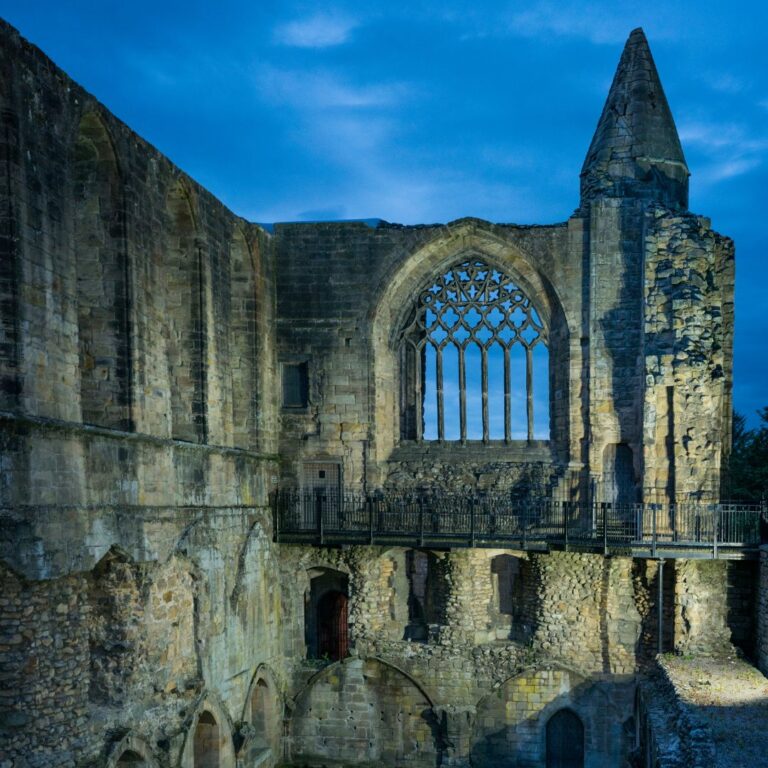
Dunfermline Abbey was founded in the 11th century by King Malcolm III and Queen Margaret. In its humble beginning it served as a Benedictine monastery and witnessed the upbringing of David I. It swiftly rose to prominence as a center of religious devotion, royal patronage, and cultural influence. The Abbey is known for being the final resting place for Scottish kings and queens, including Robert the Bruce and his queen, Elizabeth de Burgh.
If you are searching for the shrine of St. Margaret, you need to go to the outside of the east gable of the church. It has been a pilgrimage site since medieval times.
When the Scottish reformation took place in 1560 the Abbey ceased its function, but the nave of the church continued to be used as parish church. This aided greatly of the survival of the building to this day.
Today, the Abbey is run by Historic Environment Scotland (HES)
This enables you to go and visit Dunfermline Abbey and Palace and check out the interior for yourself. The old medieval part of the building appears rather bare and bland, with open space but beautiful stained glass windows. Walk into the new church, it is more familiar and has the feel of any other Church of Scotland setting. Would there be not a vital component that sets it apart: The grave of King Robert the Bruce, located just beneath the pulpit and covered with a striking brass cover dating back to 1889.
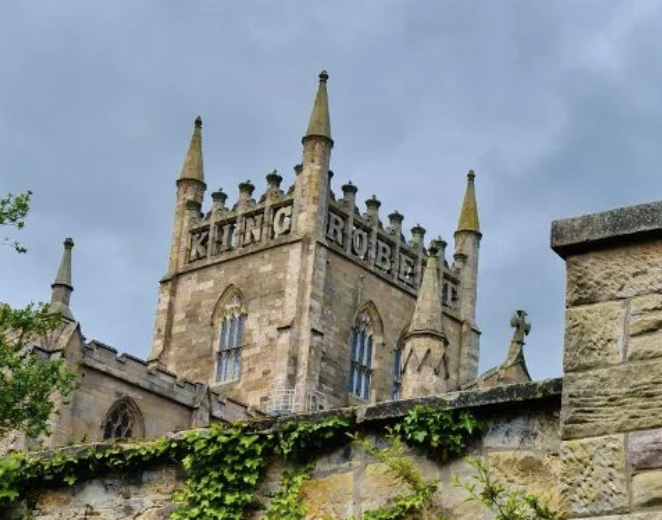
Look out for the church tower, which bears the words ‘King Robert the Bruce’ carved in stone all around.
Coat of Arms
The Dunfermline Abbey website states as follows:
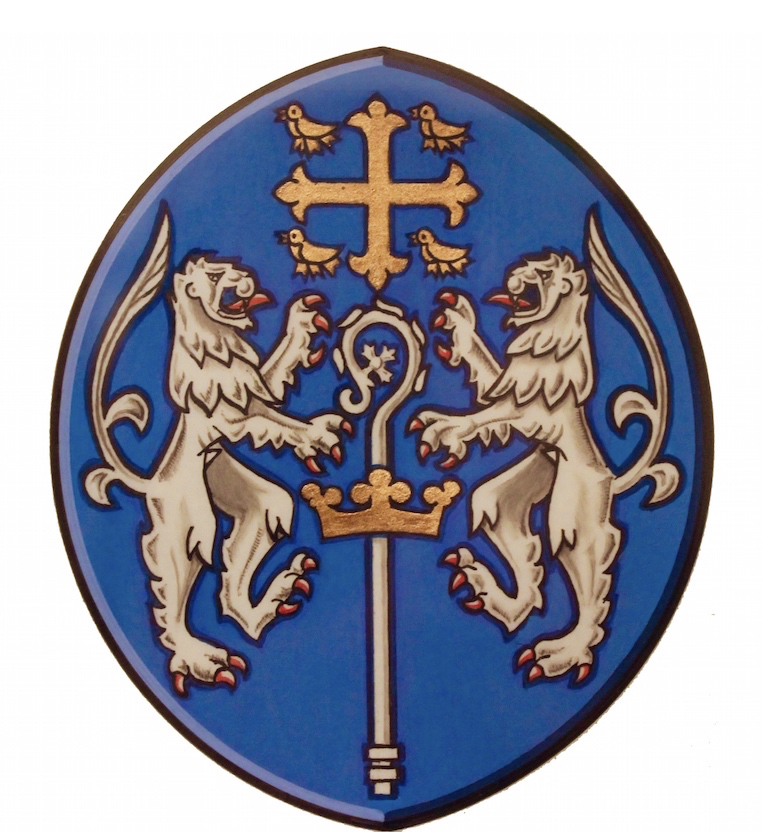
“During a visit by the Lord High Constable of Scotland, it was suggested that given its rich history (The Abbey) should have its own Coat of Arms. Dunfermline Abbey`s own Coat of Arms as formally recognised in Service of Celebration on Sunday 20th February 2005.”
“Edward the Confessor`s Coat of Arms was a cross and martletts in gold against a background of blue. He died without a direct heir and his arms passed without a direct heir to his collateral Margaret, who subsequently became consort of Malcolm III of Scotland and settled here in Dunfermline.
Since Dunfermline Abbey was founded by her it has the right to use her coat of arms. Following the due processes and given considerable work and help from the said Peter Drummond-Murray, Mark Dennis advocate and Dr James Floyd from the Heraldry Society of Scotland along with the advice from the Earl of Elgin and Kincardine.
The Abbey`s request has been granted by the Lord Lyon King of Arms, thus we now have our own Coat of Arms granted in the name of the Minister and Kirk session of Dunfermline Abbey.”
Pittencrieff Park
The leafy green of Pittencrieff Park is a beautiful sanctuary, bought and donated to the City back in 1835 by Andrew Carnegie. It’s a lovely spot to find many little nooks and crannies. You may even stumble across signposts for the Wallace Well. The story goes that the guardian of Scotland and freedom fighter William Wallace hid near the well from his enemies after the loss of the Battle of Falkirk.
Wallace knew of the importance of Dunfermline and it is said that he buried his mother here in secret without a marker stone, but under a thorn tree in the abbey graveyard. Look out for the plaque in the Abbey grounds that marks the spot.